Anggoro Budi Nugroho
(Professor of Economics, School of Business and Management. SBM, Bandung Institute of Technology.
A PhD in Economics, Université de Limoges LAPE, France)
(Professor of Economics, School of Business and Management. SBM, Bandung Institute of Technology.
A PhD in Economics, Université de Limoges LAPE, France)
We need to examine the empirical analysis of the high cost of our parliament (the House of Representatives – DPR RI) and its productivity, in light of the unrest that has swept across various levels of Indonesian society over the past two weeks, in response to the Prabowo-Gibran cabinet’s policy of increasing the allowances of DPR RI members, and their public response, which has been deemed unempathetic and hurtful to the public.
Comparative Perspective Our parliamentary budget is among the most expensive in its class, specifically for countries with a comparable Gross National Income (GNI) or per capita income for 2024, which is USD 4,000-5,000 per year. Data from the Indonesian House of Representatives (DPR RI) itself shows that in 2024, the total budget requested from the Government (Executive) for the current year was USD 663 million (Rupiah exchange rate of Rp. 15,000/USD, the post-pandemic 'wave level'), or the equivalent of approximately Rp. 10 trillion per year (KONTAN, April 4, 2023). Meanwhile, other countries with similar levels of economic development in the immediate region, such as Vietnam and the Philippines, have parliamentary budgets ranging from USD 150-300 million per year.
If we use another second comparison basis, namely total population (to illustrate the degree of representation, such as electoral districts in Indonesia), we are not far behind in this picture. The People’s Republic of China (PRC), with a population of over 1 billion, has a parliamentary budget of just under USD 200 million annually, a third of ours, while its GNI per capita is already more than three times Indonesia’s. Meanwhile, India, Nigeria, and Pakistan, whose populations are roughly equivalent to Indonesia's, each have an annual parliamentary budget of only around USD 50-300 million. Ours, on the other hand, is more than three times that.
Furthermore, if we use the perspective of the regional minimum wage multiple in each country, our parliamentary budget (DPR) is equivalent to IDR 18.7 billion per year for each member, or 288 times the average Regional Minimum Wage (UMR) in Indonesia, which is currently IDR 5.4 million per month, with Bekasi City having the highest, or 718 times if we use the UMR for residents of Banjarnegara Regency, which is currently the lowest in Indonesia, at only IDR 2.2 million per month. This multiplier is far greater than that of China, whose GNI per capita is already above USD 12,000 per year and whose population is 1.4 billion, and Vietnam, which are only 19 and 185 times the lowest wage, respectively. Undoubtedly, from an economic ethical or normative economic perspective, we are disturbed by this reality. For example, if China, even though it has become so prosperous and wealthy, its parliamentarians are willing to live simply and modestly.
Productivity Perspective
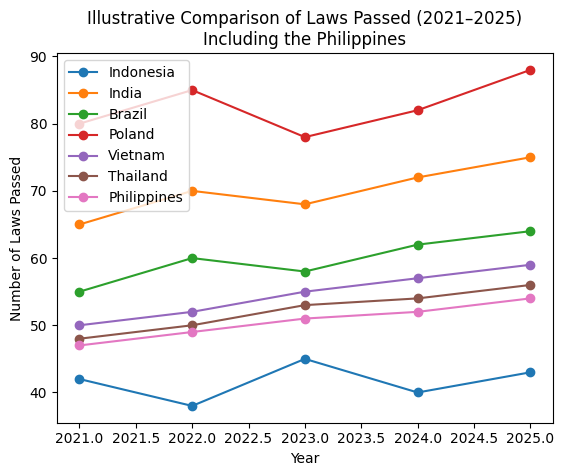
Meanwhile, in terms of productivity, our 580 members of parliament (DPR-RI) remain inferior to several countries with lower or more affordable parliamentary budgets. India, with its parliamentary system called the Lok Sabha and Rajya Sabha, passed approximately 331 laws in the five-year period from 2019 to 2024, according to data from the Geneva-based International Parliamentary Union (IPU). This is despite its annual budget being just under USD 300 million (ours is USD 663 million).
Meanwhile, Poland, with its parliament called the Sejm, and Nigeria's National Assembly, produced 640 and 331 laws, respectively, in the same period. Indonesia (the House of Representatives) only produced 225 laws, equivalent to an average of 45 laws per year, with a budget of USD 663 million. Poland and Nigeria each spent only USD 160 million and USD 300 million annually. Half, or even a quarter, of our DPR's budget. And far more productive.
If we compare the productivity ratios of parliamentarians in these countries with our DPR, we get a figure of 4 for Poland, 0.11 for Nigeria, and 0.07 for Indonesia. In context, the cost of producing laws is per unit of output (the higher the number, the more productive). This comparison reveals that we are relatively unproductive (our DPR's productivity is low) and expensive. This is certainly a cost to the people, considering they are funded by tax money in the State Budget (APBN), the use and allocation of which is approved by the Government (President and Vice President) as the Executive.
Ethical Axiology
Therefore, considering the 2019-2024 IPU data and the various analytical facts above, our conscience as the public is certainly disturbed again. The Indonesian Parliament is already expensive, and its productivity is still below that of other countries. Perhaps this is the expression of feelings that will arise among the lower classes who don’t understand these things. The demonstrations sparked by public anger at the end of August 2025 must be interpreted with contemplation and a reformist attitude.
First, be fair to the people. To professions that should be the most crucial for developing the nation, yet are underpaid. For example, teachers, even those still on contract. Stop viewing teaching as a low-paid profession. South Korea, Japan, and Singapore, which gained independence later than us, yet recognize that humans are our only resource, thus paying teachers high salaries and taking the SAT (Scholastic Aptitude Test) seriously, as in the United States, ultimately overtaking us in productivity, still consider teaching a profession that deserves no proper respect. Meanwhile, members of parliament are paid more than 58 times as much.
Second, the House of Representatives, as a parliament, experiences a deficit of wise people. Marcus Tullius Cicero (106-43 BC), a Roman philosopher and historian, stated that there are three professions that are held by at least the best in society: 1) teachers/lecturers, 2) religious figures, and 3) senators, members of the people's representatives. Therefore, we must stop recruiting people who are merely well-known (famous) as members of parliament, solely for the sake of gaining narrow votes. This will impact the organizational culture of parliament, as well as the individual values they carry with them when serving before the people. It’s like dancing amidst the public's melancholy while enjoying increased allowances, a lack of empathy, partisanship, and so on.
First, be fair to the people. To professions that should be the most crucial for developing the nation, yet are underpaid. For example, teachers, even those still on contract. Stop viewing teaching as a low-paid profession. South Korea, Japan, and Singapore, which gained independence later than us, yet recognize that humans are our only resource, thus paying teachers high salaries and taking the SAT (Scholastic Aptitude Test) seriously, as in the United States, ultimately overtaking us in productivity, still consider teaching a profession that deserves no proper respect. Meanwhile, members of parliament are paid more than 58 times as much.
Second, the House of Representatives, as a parliament, experiences a deficit of wise people. Marcus Tullius Cicero (106-43 BC), a Roman philosopher and historian, stated that there are three professions that are held by at least the best in society: 1) teachers/lecturers, 2) religious figures, and 3) senators, members of the people's representatives. Therefore, we must stop recruiting people who are merely well-known (famous) as members of parliament, solely for the sake of gaining narrow votes. This will impact the organizational culture of parliament, as well as the individual values they carry with them when serving before the people. It’s like dancing amidst the public's melancholy while enjoying increased allowances, a lack of empathy, partisanship, and so on.
Third, almost all revolutions in history have occurred due to budgetary injustice, even accompanied by deceit on the part of members of power. For example, in France in the 18th century. So, we must stop exploiting the people with taxes, while the elite use them without accountability, fairness, and transparency. Engels (1820-1895) warned: ‘Hungry people are angry people.’; If the government, as the executive branch, and the House of Representatives (DPR-RI), as the legislature, fail to address this issue immediately, it is possible that even worse unrest will occur in society.
Fourth, for the executive branch: moral policy. With the Indonesian people's GDP only fluctuates at an average of USD 4,000-5,000 per year for nearly six years, on par with Morocco and Iran, and not increasing in nearly five years since the pandemic, while DPR members; allowances have increased by 20-75 percent in the same period as the massive housing budget plan, the attitude of dancing around policy choices that benefit a group of their own mobocratic elites is clearly deeply hurtful to the public. Stop it. Distribute state budget liquidity as a development incentive, which has the potential to leverage growth and minimize inequality among the lower classes. The rise of the Composite Stock Price Index (IHSG) by 57.2 percent in the last 5 years, followed by a decline in people’s purchasing power through cumulative inflation of 16.99 percent from 2019 to 2024, a slowdown in the contribution of consumption to GDP of 8.33 percent, and unemployment through layoffs of more than 24 thousand people in just the period of January to April 2025 (one-third of the total layoffs in 2024), shows that the justice that should be received by the majority of people through the ‘trickle-down’; effect which has been the main prima donna in the moral reading of development as the main means of driving economic justice for society through development (World Bank, 2006, 2022), has not occurred. Is this fair?